
On this page
How seamless gutters are made
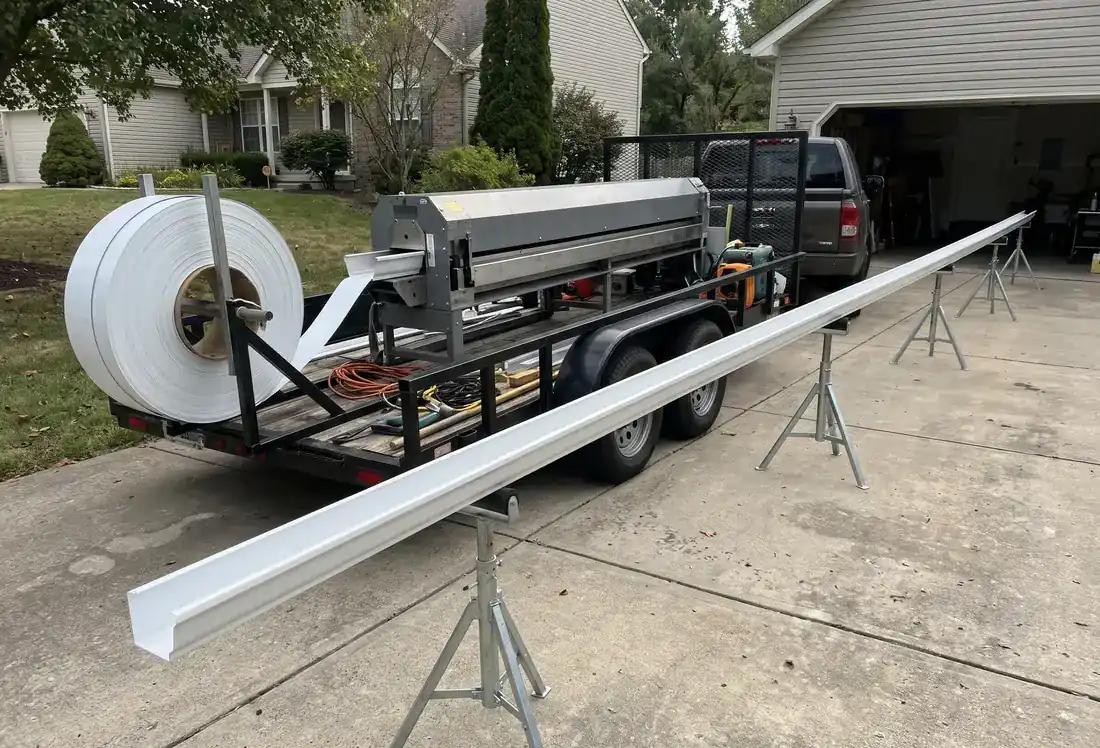
The contractor arrives with a roll-forming machine, usually on a trailer or in the back of a truck, loaded with a coil of pre-painted aluminum. The flat sheet is fed through a series of rollers that bend it into the familiar K-style profile. The machine keeps running until the gutter is as long as the eave, plus a little to trim.
That one-piece run is carried to the house, end caps fitted, outlets cut, and hung. Corners are mitred from two pieces and sealed, or made with pre-formed corner pieces.
Why joints matter
Every joint in a gutter is a place where sealant has to do the job of metal. Sealant ages: summer sun on a south-facing gutter, winter freeze-thaw and the occasional coat of ice all work on it. Sectional gutters, sold in 10-foot lengths, have a joint every 10 feet. A 40-foot run therefore has three seams before you count corners. A seamless run has none.
The seamless vs sectional guide goes through the comparison in detail.
Sizes and profiles
- 5-inch K-style: the most common residential size. Suits many one-storey homes with moderate roofs.
- 6-inch K-style: carries much more water. Suits large or steep roofs, long runs and valleys. See 6-inch gutters.
- Half-round: can also be formed seamless on some machines, for older houses. See half-round gutters.
Coil comes in several thicknesses. Heavier coil resists denting from ladders and falling branches, which is worth considering under big trees.
How they are hung
Seamless gutters are only as good as their hangers. Modern practice is hidden screw-in hangers, clipped inside the front lip and screwed through the back of the gutter into the fascia and rafter tails. They are invisible from the ground and far stronger than the old spike-and-ferrule method.
Spacing matters. Many installers use 24 inches; asking for closer spacing on runs under trees, or on houses that collect ice, is reasonable. The weight of wet needles, ice glaze or a branch is spread over more fixings.
Slope is set with a chalk line or level, falling toward each outlet. Too little and water stands in the trough; too much and the gutter looks crooked on a long elevation.
Common problems, and how to avoid them
- Corner leaks. Sealant at mitres is the weak point. A good installer cleans the metal, uses gutter-grade sealant and rivets as well as seals.
- Sagging. Usually from too few hangers or hangers into rotten wood. Fascia should be checked before installation.
- Overflow in downpours. Gutters undersized for the roof, or too few downspouts. Sizing should be from the roof, not from habit.
- Dents. Thin coil and ladders do not mix. Heavier coil helps.
Local fit
High Point's rain comes heavy. The NOAA normal at the High Point station is 48.27 inches a year, and short summer storms deliver much of it. Seamless runs drain smoothly because there are no internal seam lips for debris to catch on, which also helps on wooded lots where pine needles are a constant.
On older homes with soft or uneven fascia, the seamless run will show every dip. A good contractor straightens or replaces the board first.
Repair versus replacement
If a seamless run is bent in one place, a section can be cut out and patched, but on a visible elevation many owners prefer a new run, which can be formed in minutes on site. If the run is sound but sagging, re-hanging with new screws and extra hangers usually fixes it.
Questions to settle before the machine arrives
Because seamless gutters are formed on the day, decisions have to be made before the crew starts:
- Color. Coil is loaded on the machine. Pick from samples in daylight against your trim, not from a screen.
- Size per run. Some runs may warrant 6-inch while porches stay 5-inch. Agree which.
- Downspout positions. Mark where each will go and where it will discharge, so outlets are cut in the right places.
- Guards. If you want guards now or later, tell the installer, because some guards need a particular hanger or a specific front-lip shape.
- Fascia. Agree in advance how rotten wood found on the day will be handled and priced.
Seamless on older and newer houses
On a 1920s house in Emerywood or Sherrod Park, seamless runs may have to follow eaves that have settled over a century. The installer may need to shim or straighten the fascia so the gutter can keep a true fall. On a new house in Oak Ridge or Summerfield, the challenge is the opposite: long, high eaves and big roof planes, where 6-inch seamless and extra outlets are common.
What affects cost
- Total length and number of corners.
- 5-inch or 6-inch, and coil thickness.
- Number of storeys and roof steepness.
- Downspout count and length.
- Fascia repairs found during removal.
- Guards added at the same time.
Prices are per foot; the cost guide and calculator on the installation page give national ranges.
Seamless gutter specifications to put on the quote
| Item | Typical options | Why it matters |
|---|---|---|
| Profile | 5-inch or 6-inch K-style; seamless half-round on some machines | Sets capacity and look |
| Coil thickness | Around .027 to .032 inch aluminum | Thicker resists dents from ladders, limbs and hail |
| Finish | Baked-on enamel in dozens of colors | Fade and chalk resistance |
| Hangers | Hidden screw-in, at 24 inches or closer | Holds weight of water, needles and ice |
| Corners | Mitred on site or pre-formed; riveted and sealed | Corners are where most leaks start |
| Outlets | Cut and crimped drops for 2x3 or 3x4 downspouts | Bigger outlets clog less |
| Downspouts | Strapped top, middle and bottom | Stops rattling and blow-offs in storms |
Capacity in local storms
NOAA's Atlas 14 figures for High Point give a 10-year, 5-minute intensity of 6.97 inches per hour. Using the sizing method This Old House describes, a 5-inch seamless K-style gutter rated at 5,520 adjusted square feet serves roughly 790 square feet of roof plane at that intensity before the pitch factor is applied. That is plenty for many porch and one-storey runs, but large two-storey planes often need 6-inch or an extra outlet.